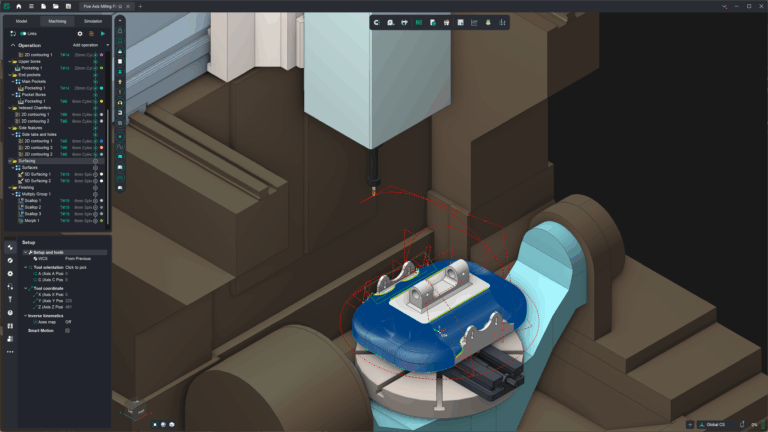
Five-Axis Milling

Five Axis machining demystified! It's complex, but not as intimidating as it looks.

7 lessons1h 30Tier 414 languages
Sign in to enroll

About course

This series is all about getting to grips with five-axis machining. We're going to work with both indexed and continuous machining operations to complete the part, and we'll be drawing on every skill we've covered so far in the three and four axis machining courses. We're also going to introduce Transformations, new ways of using the Multiply Group functions and different options within the Safe Surface definitions.

Five axis machining is complex, challenging and deeply rewarding, and is an excellent way to really show your expertise in the machining and programming world.

It's worth noting that once you start to get into this deep end of programming, automated systems won't always save you. While tools like the avoid collisions algorithm are used in this series, sometimes you'll have motions so complex that even the computer needs a helping hand to get things right - be prepared to start really flexing your skills with custom  approach and return rules, self-defined motions between operations, and precise edits to toolpaths.


Author

Files

Gerry Grainger

Used in the course — download before starting:

Gerry Grainger

Training content producer

Languages

العربيةDeutschEnglishEspañolFrançaisעבריתहिन्दीItaliano日本語한국어NederlandsPolskiPortuguês中文

Take the course and get a certificate!

Add this certificate to your resume to demonstrate your skills and increase your chances of getting noticed.
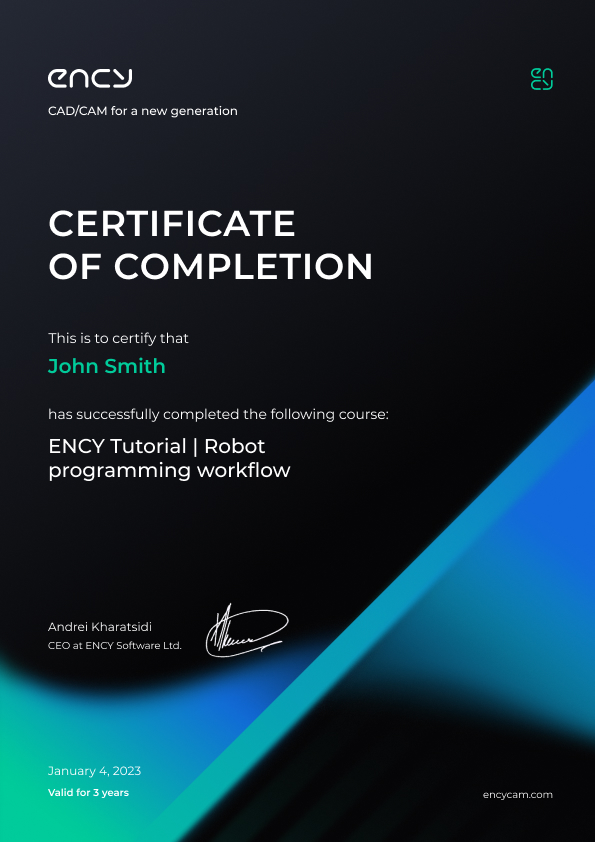
Certificate preview

Lessons

7 lessons to go

  1. 1Vertical RoughingThis section covers the setup and execution of roughing operations using 5-axis machining, focusing on indexed and continuous strategies. It includes generating toolpaths for vertical machining, 2D contouring, and 3D flatland operations, emphasizing material removal and tolerance management. The session also highlights techniques for optimizing machining paths and preparing for more complex operations.Video lesson
  2. 2Upper featuresDefine and execute 2D contour operations using a 20mm end mill to clean up upper tabs and contours. Set tool orientations, top and bottom levels, and utilize multiply groups for efficient machining on indexed parts. Simulate operations to ensure clean cuts and avoid collisions while preparing for further pocketing tasks.Video lesson
  3. 3Indexed Pocketing and ChamferingDefine and generate toolpaths for angled end pockets using pocketing operations with specified A and C-axis angles. Adjust parameters such as relief angles and safe levels to ensure proper machining, and create multiply groups for efficient tool changes. Transition to finer details with a smaller tool for pocket bores and chamfered transitions, optimizing lead-ins for smooth operations.Video lesson
  4. 4Side featuresThis section covers the creation and adjustment of 2D contouring operations for side tab features, including setting toolpath parameters and addressing gouge errors. It demonstrates the use of helical machining and the importance of proper curve selection, along with techniques for mirroring operations and optimizing transitions for collision avoidance. The focus is on achieving clean toolpaths for effective machining.Video lesson
  5. 5Continuous SurfacingThis section covers fully continuous 5-axis surface machining, focusing on defining a surfacing operation and managing tool orientation for optimal results. It includes strategies for gap capping and safe surface motions, ensuring uniformity in surface finish while transitioning between curves. The process culminates in simulating the toolpath and verifying results for consistency.Video lesson
  6. 6Continuous FinishingFinalize machining by defining finishing operations, including scalloping and morph toolpaths, to address un-machined sections. Adjust tool angles, job zones, and depth limits for optimal results, while ensuring safe motion levels. Simulate and verify toolpaths to confirm clean transitions and effective edge tidying, demonstrating practical techniques for complex geometries.Video lesson
  7. 7Assignment – Five Axis MachiningReading· Assignment required

Course discussion

Loading discussion…

0/6000