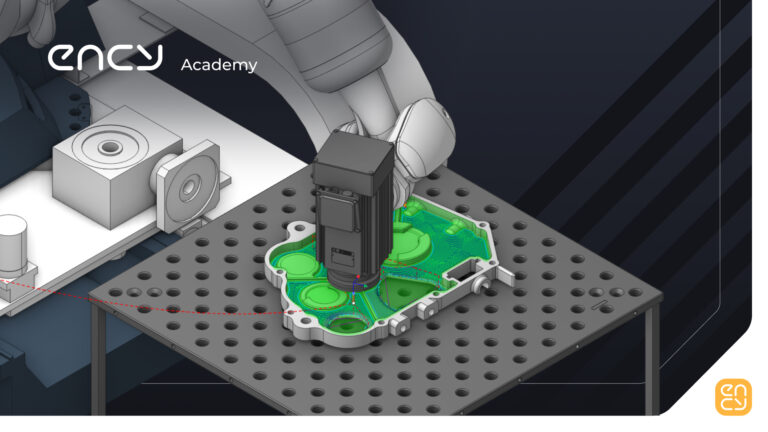
2D and 3D Milling with ENCY Robot

Milling with robots? Start here—learn 2D and 3D toolpaths

8 lessons1 hr 30 minTier 214 languages
Sign in to enroll

About course

This course of lessons covers the use of a KUKA KR90 robot with a milling spindle end effector to machine an enlarged model of an engine crankcase half, showcasing the 2D and 3D machining possibilities that are available with robotic cells. While we'll cover more complex operations with robots in the future, this serves as a good introduction to managing workflows  and operations with a robot.

As you’ll discover, ENCY’s workflow makes potentially complex parts easy and intuitive to work with.

Join the course and see for yourself how simple it is!
📁 Don’t forget to download the required files before starting the training.


Author

Files

Gerry Grainger

Used in the course — download before starting:

Gerry Grainger

Training content producer

Languages

العربيةDeutschEnglishEspañolFrançaisעבריתहिन्दीItaliano日本語한국어NederlandsPolskiPortuguês中文

Take the course and get a certificate!

Add this certificate to your resume to demonstrate your skills and increase your chances of getting noticed.

Certificate preview

Lessons

8 lessons to go

  1. 1Face Milling and Roughing WaterlineImport and set up roughing operations for a workpiece using a robot cell, defining the workpiece dimensions and tool orientation. Establish a 3D entry face milling operation and a roughing waterline path, adjusting parameters for tool size and collision avoidance. Simulate the machining process to verify toolpaths and ensure accuracy in material removal.Video lesson
  2. 2Rough PocketingThis section covers pocketing techniques in machining, focusing on clearing deeper elements and boring holes. Participants learn to set up 2D pocketing operations using different tool sizes for tight spaces and adjust top and bottom levels for accurate machining. The session emphasizes toolpath generation and simulation for effective clearance operations.Video lesson
  3. 3Flatland SurfacingThis section covers surfacing operations for machining flat and rolled surfaces using the Flatland operation. It details the setup process, tool selection, job zone definition, and tool path generation, emphasizing the importance of precise job assignments to avoid unwanted machining areas. The session concludes with strategies for managing complex geometries and preparing for subsequent operations on non-planar surfaces.Video lesson
  4. 4Optimised Plane for Internal SurfacesOptimize planes for surfacing operations using a 5mm ball nose tool to achieve clean rounded surfaces. Select curved surfaces for machining, define job zones, and generate toolpaths while addressing common issues like zero-degree deflection in robotic milling. Simulate toolpaths and assess gouges to ensure tolerances are met before proceeding with profiling and finishing cuts.Video lesson
  5. 5Internal 2D and 3D ContouringDefine and generate finishing toolpaths using 3D contouring and 2D contouring techniques for precise machining. Clean up interior profiles and ensure correct tool offsets to achieve optimal surface quality. Simulate and verify toolpaths to confirm material removal and refine final dimensions for a completed part.Video lesson
  6. 6External 2D and 3D Contouring with CleanupMating surface finishing and exterior contouring are performed using various milling operations, including face milling and 2D contouring. The course covers generating toolpaths, simulating machining processes, and addressing non-planar regions with optimized planes and 3D contouring techniques. Participants learn to refine their machining strategies for achieving precise tolerances and clean finishes.Video lesson
  7. 7Troubleshooting and Final CleanupResolve toolpath issues by adjusting link clearance height and safe distance settings to eliminate rapid feed errors. Implement lead-in and lead-out strategies for 2D contour operations, and create new 3D finishing planes to clean up internal sections. Utilize 3D contouring paths to refine edges while ensuring proper tool engagement to avoid gouging.Video lesson
  8. 8Assignment – 2D/3D Robot MillingReading· Assignment required

Course discussion

Loading discussion…

0/6000